5 Signs Your Growing Ingredient Business Needs a Distribution Partner
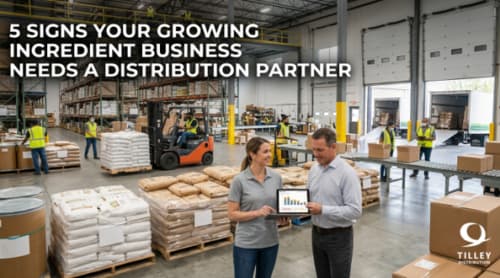
Most ingredient manufacturers don’t wake up one day and decide they need a distribution partner. It’s usually a slower realization – the same problem keeps showing up in different forms, month after month, until it’s clear the way you’ve been doing things doesn’t scale anymore. Here are five signs worth paying attention to.
1. You’re turning down orders you shouldn’t have to turn down.
A new customer wants product delivered to three regional locations on a rolling schedule. Your current shipping setup can barely handle two. So, either you take the order and scramble, or you pass on it and hope they call back next time they need volume. If you’re saying no to good business because the logistics side of things can’t keep up, that’s not a sales problem. That’s a distribution problem.
2. Your warehouse is doing double duty as a bottleneck.
Inventory used to be simple: make it, store some, ship it out. Now you’re holding more raw material and finished product than your space was built for, and every square foot you add to storage is a square foot you’re not using for production. When growth starts competing with itself for space, warehousing access outside your own four walls is worth a serious look.
3. Compliance paperwork is slowing down sales, not just production.
Buyers in nutrition, pet food, and specialty chemicals ask harder questions than they used to. Certificates of analysis, regulatory documentation, requirements that vary by state or country. If your team spends more hours on paperwork per order than they used to spend on the entire sale, that’s time not spent making product or finding the next customer.
4. Customers want technical answers faster than you can give them.
A customer’s formulation team calls with a compatibility question or a performance spec that doesn’t quite match your spec sheet. If no one on your team can turn that around quickly, the order sits, or worse, it goes to whoever answers first. Technical support isn’t a nice-to-have anymore. It’s part of how ingredients get sold.
5. You’re spending more time chasing new markets than making product.
Every hour spent building relationships in a new market is an hour not spent running your line. Expanding on your own means starting from zero with new customers, new logistics, and new regulatory hurdles in a category you don’t know as well. That’s expensive and slow to do alone.
What this usually means.
If any of these sounds familiar, it doesn’t mean something’s wrong with your business; it usually means you’ve grown past what your current setup was built to handle. A distribution partner isn’t about giving up control of your customer relationships. It’s about handing off the warehousing, logistics, compliance, and quality control work so your team can focus on what they do best: making a good product.
That’s the gap Tilley Distribution fills for manufacturers across human nutrition, pet food, flavor and fragrance, lubricants, and specialty chemicals and CASE. If any of the five signs above sound familiar, it’s worth a conversation. Contact us at Sales@TilleyDistribution.com
Category
- Supply Chain Management
Share this article